I’m not, nor would claim to have the ability to be, a professional literary reviewer, but I do like sharing my thoughts on books. So here goes with the first one.
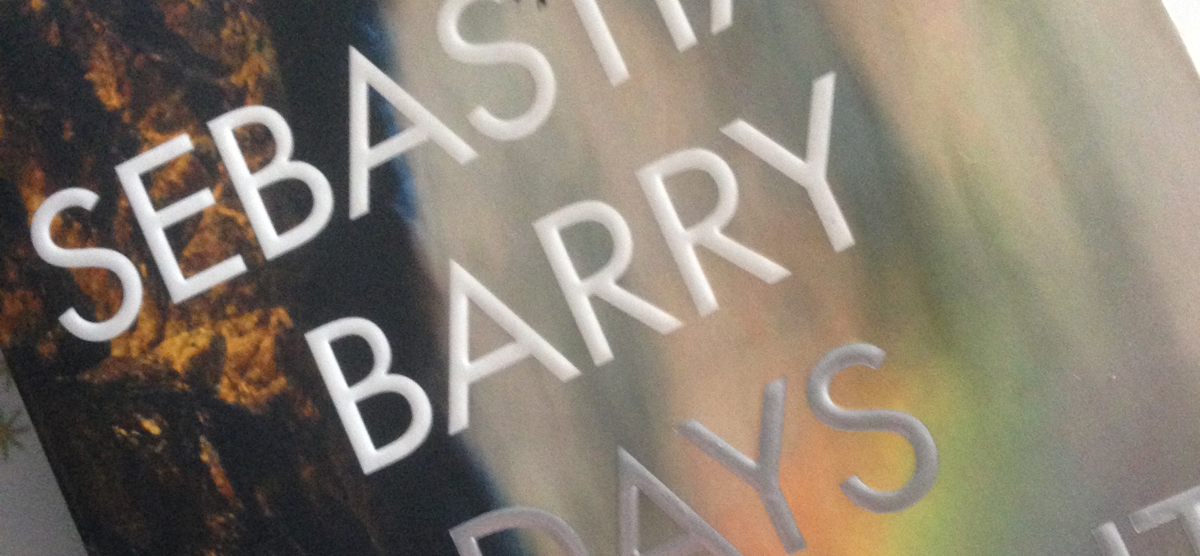
I was late to the party on Sebastian Barry’s Days Without End and plenty has been said about its award-winning qualities. It is, in my humble opinion, a worthy award winner and I loved it, but it’s not to everyone’s taste. I encouraged T’otherarf to read it and his review was: “It got better towards the end because you knew you were coming to the end.” It seems the reader had had enough of what he saw as Barry’s repetitiveness and was glad when it was finished, ironic considering the book’s title!
The repetitiveness that may offend one reader is also what drives home the major themes in this book. History keeps repeating itself in the form of wars against an enemy who is different to you, the ‘other’. It is a romance, a tale of courage and humanity, an account of how hatred and inhumanity can drive people, but primarily a story of fear of the other, the alien.
From the start the reader is on guard to what they’re being told. The book title is challenged in the first sentence as the reader is faced with the end of days, the laying out of a corpse. And the narrator, Thomas McNulty, is a self-confessed unreliable teller of tales: “The mind is a wild liar and I don’t trust much in it that I find there.” The reader can’t totally trust much of what Thomas says, yet there’s a ring of truth in all of it.
Whether Thomas is hunting buffalo or fellow Americans, Barry’s vivid descriptions of action and emotion show how a person can switch off their humanity. Thomas’ initial killing days are driven by the fear of hunger – a recurring theme from his childhood days – as he hunts the buffalo: ‘You gotta treat a buffalo like a killer…she wants to kill you before you kill her.’ The ‘kill or be killed’ mantra is what drives Thomas on in other encounters. Life has little or no value, whether it is Irish refugees, who are ‘rats of people’, or ‘evil’ Indians, or the ‘ghosts and ghouls’ who make up the Rebel army. All are the other, the enemy, a threat to be removed.
Thomas is both disgusted by his actions and intoxicated by the exhilaration, like a dog after slaughtering lambs. People are no longer human, but ghosts in a dislocated world and a ‘queer lust and something akin to cruelty’ takes over his psyche.
The dark themes are brilliantly portrayed by Barry’s language, especially his use of light and shade, contrasting with the happier times and moments of colour, a duality that mirrors the emotions of the characters. Barry’s metaphors and similes add depth to the darkness, challenging all the senses with taste, textures, smells and sounds. Examples include:
- John Cole, the love of Thomas’ life, has a name evoking the image of the hard, black fuel, with his “river-black eyes”, his dark face, and dressed in ‘an old queer black suit’;
- the stampeding buffalo are like ‘a big boil of black molasses in a skillet’;
- the bright morning is ‘cold as dark dreams’.
- And the world is dark when America turns on itself, a civil war, with the same people on both sides, Irish against Irish in their attempt to be patriotic Americans. ‘The darkness is nearly complete’ as the battle ends and the moon ‘throws down her long fingers of nearly useless light’.
The book also explores the duality of identity, ‘you’re talking to two when you talk to one Irishman’. Thomas is constantly facing the complexity of his own nature, feminine and masculine, lover and killer, human and animal, which mirrors the conflicting identities at war within America, a divided nation. A tale for today.
 Rumblings from The Growlery